News
KACRAN raises alarm over livestock exodus, warns of threat to food security

By Philippine Duru
philippineobetoduru@gmail.com
08034905774
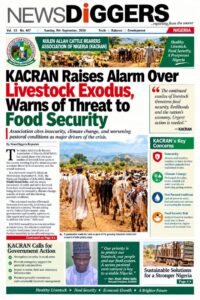

The Kulen Allah Cattle Rearers Association of Nigeria (KACRAN) has raised the alarm over the growing movement of livestock from Nigeria to other African countries, warning that the trend could threaten the nation’s food security, economic growth and national security.
The association called on Northern governors and other political leaders to urgently address the situation by strengthening livestock production, improving security and introducing policies to protect the country’s breeding stock.
In a press statement signed by its National President, Hon. Khalil Mohd Bello, and dated September 29, 2026, KACRAN expressed concern over what it described as a massive depletion of Nigeria’s livestock resources.

According to KACRAN, the situation has worsened in recent years, with pastoralists and their animals reportedly moving to neighbouring African countries in search of safer and more favourable conditions.
The association identified Gabon, the Central African Republic, Benin Republic, Togo, Burkina Faso, Cameroon, Chad and Ghana among the destinations, while also citing increased livestock movement to Southern Nigeria.
KACRAN expressed particular concern over the increasing number of cattle, sheep and rams reportedly transported from major livestock markets in Northern Nigeria to other African countries.
It identified Potiskum, Damaturu, Maiduguri, Ngalda and Gombe as some of the markets affected by the trend.
The association claimed that about five trailers of sheep and rams leave the small ruminants market in Potiskum daily for destinations in Burkina Faso, Côte d’Ivoire and Togo.
It further alleged that the volume of livestock transported to these countries now exceeds the number traditionally supplied to Southern Nigerian markets.
While acknowledging that livestock trading across borders is a legitimate business, KACRAN argued that greater efforts should be made to retain more of the trade within Nigeria by encouraging traders to supply markets in Lagos, Port Harcourt, Asaba and other Southern cities.
According to the association, such a strategy would help retain economic value within the country and improve domestic livestock availability at a time when insecurity and diplomatic challenges have reportedly affected livestock supplies from neighbouring Niger Republic, Chad and Cameroon.
The association warned that the continued movement of livestock out of Nigeria could further increase prices, making animals increasingly unaffordable for ordinary citizens during religious celebrations and other social occasions.
It cited current ram prices ranging from ₦300,000 to ₦1 million, depending on size, as an indication of the growing financial burden on consumers.
KACRAN also expressed concern that the situation could make it increasingly difficult for Nigerians to purchase livestock for Eid-el-Kabir and other celebrations if urgent measures are not taken.
The association stressed that protecting domestic livestock production was essential to food security, job creation and reducing Nigeria’s dependence on imported milk, meat and other livestock products.
To address the situation, the association urged Northern governors and political leaders to introduce immediate measures to protect the country’s livestock resources and strengthen the sector.
Among its recommendations, KACRAN called for an immediate embargo on the exportation of female animals and young breeding stock to other countries to protect Nigeria’s breeding capacity.
It also urged governments to identify major livestock exporters and provide them with soft loans and incentives to redirect their businesses towards domestic markets, particularly in Southern Nigeria.
The association further called for increased investment in livestock development through the rehabilitation of grazing reserves and cattle routes, alongside the provision of animal feed and reliable water points.
On security, KACRAN urged authorities to intensify efforts to combat cattle rustling and banditry, which it said had contributed significantly to livestock losses in the North-West, North-East and North-Central regions.
It also advocated the introduction and multiplication of improved livestock breeds to increase production and strengthen the country’s livestock population.
Other recommendations included providing affordable loans to livestock traders, farmers, fish farmers and businesses operating across the livestock value chain.
KACRAN called on state governors, local government chairmen, traditional rulers, businesspeople, security agencies and other stakeholders to work together to reverse the reported decline in Nigeria’s livestock resources.
The association maintained that a stronger livestock sector could generate employment for young Nigerians, conserve foreign exchange, increase government revenue and contribute significantly to the country’s gross domestic product.
It warned that failure to address the challenges confronting pastoralists and livestock producers could further weaken domestic production and undermine the country’s capacity to meet its growing demand for animal protein.
The association therefore urged Northern leaders to treat livestock development as a national economic and food security priority rather than an issue affecting pastoralists alone.