
News
Interior minister denies signing agreement with UK to transfer foreign criminals

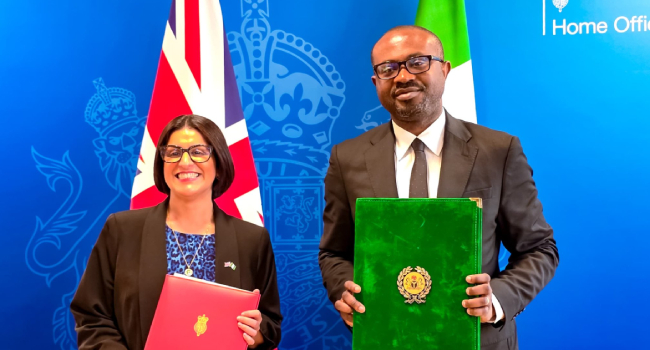
Olubunmi Tunji-Ojo, Nigeria’s Minister of Interior, yesterday described as untrue reports suggesting that the recent migration agreement signed by Nigeria and the United Kingdom would allow the transfer of foreign criminals to Nigeria.
The agreement was signed during President Bola Tinubu’s recent state visit to the UK. It is one of three key accords aimed at strengthening bilateral cooperation on migration management, border security, and economic development.
Following the announcement, the deal attracted criticism from some Nigerians, with claims that it could enable the UK to transfer criminals seeking asylum in the country to Nigeria.
Speaking on Channels Television’s Politics Today on Tuesday, Tunji-Ojo clarified that the agreement concerns only Nigerians who are out of status in the UK.
“Article 7 of the agreement says, ‘the parties will work together to secure the dignified return of their nationals who do not or who no longer have the right to enter or remain in that country.’ I have seen some things in the media where some people are saying that they want to go and bring prisoners from all over the world and dump in Nigeria.
“This government is not going to tolerate something like that. There is no way this government, under this president, will sign that sort of agreement; it’s never going to be done. What this agreement talks about are Nigerians who are overstayers or who are out of status in the United Kingdom,” Tunji-Ojo said.
The Minister insisted that Nigerians have nothing to worry about regarding the agreements with the UK government, noting that they are based on the international diplomatic model of reciprocity.
“Why do I say there is nothing to be worried about? These agreements have opened a vista of opportunities for collaboration, and I say this very clearly: Nigeria, under this administration, is not interested in exporting problems to any part of the world. We want to solve our problems. We want to put our house in order.
“We believe that irregular migration today is not just a UK problem, it’s not just an American problem—it’s a problem all over the world, including in our own country. Partnership is needed to bring all hands together to solve this problem,” he added.
Minister of Interior Olubunmi Tunji-Ojo and UK Home Secretary Shabana Mahmood (Photo by X/@MinOfInteriorNG)
‘Nothing is hidden’
He maintained that the government is not hiding anything concerning the agreement with the UK, emphasising that Tinubu’s administration believes in transparency.
The Minister noted that while the full agreement was not published, a press release by Presidential Spokesperson Bayo Onanuga highlighted every section of it.
Asked what Nigeria stands to gain from the deal, Tunji-Ojo said Article 8 of the agreement addresses the rights of returnees, stressing that they will at all times be treated with respect and dignity, with due regard to their fundamental human rights.
He described the agreement as a “50-50” arrangement for the two countries, noting that both are two sides of the same equation.
“He further clarified that the agreement is different from the controversial Rwanda asylum plan, emphasizing that it excludes family members and that each case is handled according to specific legal conditions.












A Senior Advocate of Nigeria and policy analyst, Dr. M. O. Ubani, has questioned the legal basis of a recent Federal High Court judgment directing the Independent National Electoral Commission (INEC) to deregister five political parties, arguing that the decision may have extended beyond the position previously established by the Supreme Court.
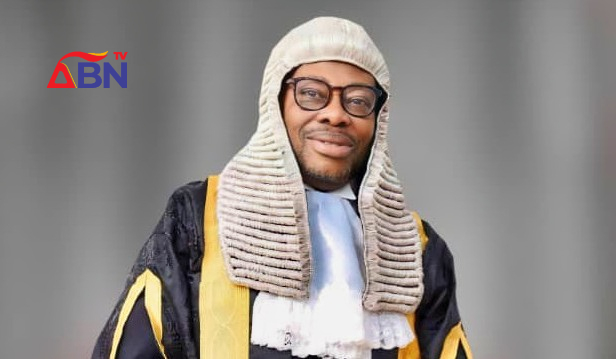
The opinion piece by legal practitioner and policy analyst, Dr. Monday.O. Ubani (SAN), has reignited discussions over the proposal for a single six-year tenure for Nigeria’s President and state governors, questioning whether the constitutional amendment would address the country’s governance challenges or merely divert attention from more pressing issues.
In a statement titled “Six-Year Single Tenure for the President and Governors: A Solution or a Distraction?”, Ubani examined the renewed advocacy for a non-renewable six-year term for chief executives at both federal and state levels.
The proposal, recently championed by Senator Opeyemi Bamidele and other supporters, is premised on the argument that elected leaders who are not preoccupied with re-election campaigns would devote greater attention to governance and long-term policy implementation.
According to Ubani, the argument possesses a degree of merit, noting that under Nigeria’s current constitutional framework, presidents and governors serve four-year terms with the possibility of one re-election. He observed that political calculations surrounding second-term bids often begin long before the expiration of a first tenure, potentially influencing policy decisions and governance priorities.
“A single tenure could potentially eliminate this concern and encourage long-term policy implementation,” he noted.
However, the Senior Advocate of Nigeria cautioned that the debate should extend beyond considerations of administrative efficiency. He argued that democracy is fundamentally anchored on accountability and good governance, with the prospect of re-election serving as a critical mechanism through which citizens assess the performance of elected officials.
Ubani warned that removing the incentive of electoral appraisal could weaken democratic responsiveness and accountability.
Drawing from comparative constitutional experiences across different regions of the world, he maintained that there is no direct relationship between the length of tenure and the quality of governance. He pointed out that several countries in the Americas and Northern Europe, despite operating relatively short executive tenures, have produced transformative leaders. Conversely, some African nations that allowed extended periods in office have grappled with poor governance, institutional decline and democratic setbacks.
He further argued that Nigeria’s own political experience demonstrates that leadership quality and institutional effectiveness have a greater impact on governance outcomes than tenure duration.
According to him, strong institutions, adherence to constitutional limits, transparency and respect for the rule of law remain the key determinants of successful governance.
From a constitutional standpoint, Ubani stated that the national conversation should not be limited to choosing between a six-year or an eight-year arrangement. Rather, he said, the focus should be on identifying a framework that best promotes accountability, political stability, effective governance and democratic development.
He acknowledged that introducing a six-year single tenure through constitutional amendment is legally feasible, provided the procedures stipulated in the Nigerian Constitution are strictly followed.
Nonetheless, Ubani questioned whether such a reform would address the underlying challenges confronting governance in the country.
“It is possible that tenure reform may alter political incentives, but it cannot substitute for competent leadership, institutional integrity and citizen participation,” he argued.
The legal practitioner stressed that effective leadership is not necessarily dependent on the length of time spent in office, noting that capable leaders can deliver meaningful results within limited tenures, while ineffective leaders may inflict greater damage even with extended periods in power.
He concluded that Nigeria’s central challenge lies not in determining how long presidents and governors should remain in office, but in ensuring that those entrusted with public office govern responsibly, effectively and in accordance with constitutional principles.
“The true measure of democratic success,” Ubani said, “is the ability to ensure that whoever occupies public office delivers the dividends of democracy while remaining accountable to the people and the Constitution.”

Ondo State Police Command has launched an intensive rescue operation following the suspected abduction of a community leader in Ode Oriya Village, Owo Local Government Area of the state.


SAN reacts to deregistration of ADC, others

Six-yr-single term: SAN speaks on right framework

Monarch’s wife shot as hoodlums abduct husband
-

 News9 years ago
These ’90s fashion trends are making a comeback in 2017
-
Entertainment9 years ago
The final 6 ‘Game of Thrones’ episodes might feel like a full season
-
Business9 years ago
The 9 worst mistakes you can ever make at work
-
News9 years ago
According to Dior Couture, this taboo fashion accessory is back
-
Sports9 years ago
Phillies’ Aaron Altherr makes mind-boggling barehanded play
-
Entertainment9 years ago
The old and New Edition cast comes together to perform
-

 News3 months ago
SERAP to Akpabio: Disclose officials involved in misappropriation of ₦200t from NNPC
-
Entertainment9 years ago
Mod turns ‘Counter-Strike’ into a ‘Tekken’ clone with fighting chickens